Skip to content
Are air purifiers safe for cats? What to use and what to avoid?
Which purifier type is suitable to use around cats?
You should check the technologies in the model you have chosen. A purifier may include an ionizer or other features for separate emissions consideration alongside a HEPA filter.
Purifier technology | What to know? |
Ionization | It charges airborne particles while some emit ozone as a byproduct. Turn the ionizer off when cats are around if your purifier has a separate ionizer switch. |
Mechanical HEPA filtration | It captures airborne particles including pollen, dander, and litter dust. It is an accurate choice for daily use if you have pets. |
Activated carbon | It absorbs some odor-generating gases. You may search for a considerable amount of replaceable carbon, if you prefer odor control. |
Ozone generation | It releases ozone that may irritate lungs. Do not use ozone-producing modes in areas where people or cats are around. |
Electrostatic filtration | It has different modes. Ozone may be produced by an electronically powered collector. Consider the emissions rate for your exact model. |
Photocatalytic oxidation (PCO) | It uses a catalyst and light to react with particular gases. Byproducts and performance differ according to model. Check emissions data and if it features ozone-producing mode. |
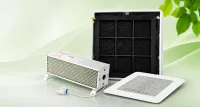
Purifiers with multiple technologies may combine ionization, PCO, electrostatic filtration, and adjustable purification modes. Check manuals to identify operating modes for each model. If you use settings with ozone-generating mode, keep the cats and people away. A mechanical HEPA unit provides a simpler setup for routine particle removal.
Can an air purifier remove litter dust and litter box odor?
Yes, HEPA air purifiers remove airborne litter dust and activated carbon technology removes some odors. You can try a low-dust, unscented litter if you see a cloud of dust while pouring litter or your cat digs. If the odor is coming from the box, you should clean the box, try scooping, and check the mat. The purifier will work for the remaining dust or odor present in the air.
If you have both issues, you may use a HEPA with a substantial activated carbon filter. Check your purifier’s CADR rate to identify if it is useful to handle airborne particles from the room. The amount of carbon can help evaluate estimated odor control.
What is the accurate placement for an air purifier in a house with cats?
What to do if your cat has asthma?
To reduce airborne particles, a mechanical HEPA purifier will control respiratory irritants at home. You should control the sources including dusty litter or smoke. Talk to your veterinarian to identify which changes are helpful for your cat. If your cat suffers from breathing difficulties, get emergency help from your veterinarian.
FAQs
Can I use an air purifier overnight if my cat is in the room?
Yes, you may use a HEPA purifier overnight with the right setting. Choose a moderate fan speed, keep the vents clear, and do not turn the ozone mode on.
Can I use an ionizer air purifier if I have a cat?
It depends on the active features and emissions level. Some ionizers generate ozone. If your purifier features a separate ionizer switch, do not turn it on and let the mechanical filter function.
Can a PCI air purifier harm cats?
It depends on the model and the mode you choose. PCO performance and emissions are different for each model. Multi-technology purifiers have a separate mode for ozone generation. Read the mode instructions carefully and search for independent emissions testing to use the purifier in a room with cats.
Can an air purifier capture cat hair?
A HEPA filter can capture fine airborne dander while a prefilter can catch loose hair that reaches the intake. Vacuuming and cleaning is required for surfaces such as carpet, sofa, or cat tree where hair are found.